
Pre-Owned Watch Dealer Software: What It Must Do
Most searches for pre-owned watch dealer software land on marketplace apps and price trackers. Those are places to list and places to look up a number. Neither one runs a dealership. Software that does has to treat a deal as one record from the first request to the closed sale, not a handoff between a CRM, a spreadsheet, and an accountant who gets the mess at month-end. Every requirement below follows from that.
Marketplace, price tracker, or operations software
Three kinds of software show up when you search this term, and only one of them is for running the business.
- Marketplaces. Chrono24's Google Play listing describes the app as a place to browse watches from verified dealers and private sellers, with escrow payment, an authenticity guarantee, and a collection tracker. It is where a buyer finds your Submariner. It does not know what you paid for it.
- Price research. WatchCharts' App Store listing describes a marketplace browser plus live market data across thousands of watch models. Useful when you are deciding what to offer on a Nautilus. Not a system of record.
- Operations software. The thing that holds the request, the sourcing work, the basis, the sale, the payments, the cut, and the number that ends up in your books. This is what the rest of this page is about.
The Watch Collectors' Club's guide to working with watch dealers tells buyers to look for a registered business address, real premises, and a professional site with detailed photographs, and notes that most dealers will buy a watch outright, sell it on commission, or take it in part-exchange. Read that from the dealer's side: your software has to carry all three deal types, and it has to keep the site and the stock list honest without someone retyping them.
Seven requirements
Test each of these in a live demo with your own stock, not the vendor's sample data.
1. Intake that holds both sides of the market
Buyer requests and seller submissions arrive by text, WhatsApp, Instagram, email, and the site form. Software has to put them on one list with the name, the reference, the budget or ask, and the last touch. If a request lives in your phone, it is not in the business.
2. Sourcing with every offer on the record
When a client wants a Nautilus you do not hold, the work is a queue: who you asked, what you offered, when you need an answer. Offers for the same watch vary widely from dealer to dealer, so the spread between your offers and the price you eventually pay is information you want to keep. Sourcing should be ordered by what is overdue and what is due today, with each offer stored against the request, not in a chat thread you will never find again.
3. Inventory with the true basis
Cost is not basis. Basis is cost plus shipping, duty, service, polishing, and anything else it took to get the piece saleable. The stock record needs:
- Cost and landed cost, kept separate
- Location: safe, showroom, out with a partner, at the watchmaker
- Owner: yours, a partner's, a consignor's
- Status: available, held, sold, returned
- Photos, serial, condition notes, and what came with it (box, papers, links, tags)
Buyers pay differently for a full set than for a watch-only example, and they price on condition and originality before anything else. Those facts belong on the record from day one so they are on the listing, the invoice, and the dispute if there is one.
4. Deals that carry the money
A deal screen should show basis, sold price, gross profit, payments received, balance due, and the invoice, on one page. Partial payments and deposits are normal in this trade. Software that cannot take three payments against one Submariner and show you what is still owed is not dealer software. Buy, sell, consign, and trade should all be deal types, not workarounds.
5. Terms and cuts on the deal from day one
Partner splits, finder's fees, and consignment percentages get agreed in a message and reconstructed when the wire lands. That is how partnerships end. The deal should hold the terms from the moment it is created, so everyone involved knows what the deal is worth before it closes.
6. Books that come from closing, not from rebuilding
Month-end should be a byproduct of the deals you closed. Gross profit per deal, revenue, aging, and a P&L should exist because the deal exists, and the entries should flow into your accounting system without a spreadsheet export in between. A lender or a partner asking for your numbers should get them in minutes, from the same record you sell from. Run a deal through the watch deal profit margin calculator to see which numbers have to be on the record for that to work.
7. The site and the feed update from the deal
When a piece sells, it should come off your site and your shopping feed because the deal closed, not because someone remembered. When a piece lands, it should be publishable from the stock record. One feed, one source of truth.
Questions to ask in the demo
Ask these with your own numbers in front of you.
- Where does a seller submission live before it becomes stock, and can I quote on it from there?
- Show me a request I cannot fill from stock. Where does the sourcing work go, and where do my offers get recorded?
- Open a closed deal. Show me basis, sold price, and gross profit without leaving the screen.
- Take two partial payments against a piece and send the invoice. What does the client receive?
- Set a split with a partner on a consigned piece at creation. Where does it show when the deal closes?
- Close a sale. What happened to the site and the shopping feed?
- What does month-end take, and who does it?
- How many logins do I need for a partner and an associate, and what do they cost?
- How do I get my data out: stock, deals, clients, in a format I can open?
- If I come off a spreadsheet, who loads it, and what does setup cost?
If the answer to any of these starts with "you would export that to," the deal is a handoff, not a record.
Flat pricing versus per-seat
Two pricing shapes dominate this category.
- Per-seat, with modules. You pay for each user, and core functions like accounting sync, invoicing, or the web feed sit in a higher tier. Adding a partner or an associate becomes a software decision. Turning on the function you need to close your books becomes an upgrade conversation.
- Flat, for the company. One price covers the whole operation and everyone in it. Adding a person adds a login, not a line on the invoice.
Work it through for a typical shop: you, a partner who sources, an associate who handles intake, and a bookkeeper who needs read access. Under per-seat pricing that is four seats before you have added a tier for the functions in requirements 4, 6, and 7. Under a flat plan the count does not matter. For a business trying to add people, the second shape is the one that does not punish growth. Our comparison of watch dealer software sets the tools in this category side by side.
Where Movement OMS fits
Movement OMS is built around the one-record idea described above. It covers watch dealers first, and bag, art, and car dealers on the same model.
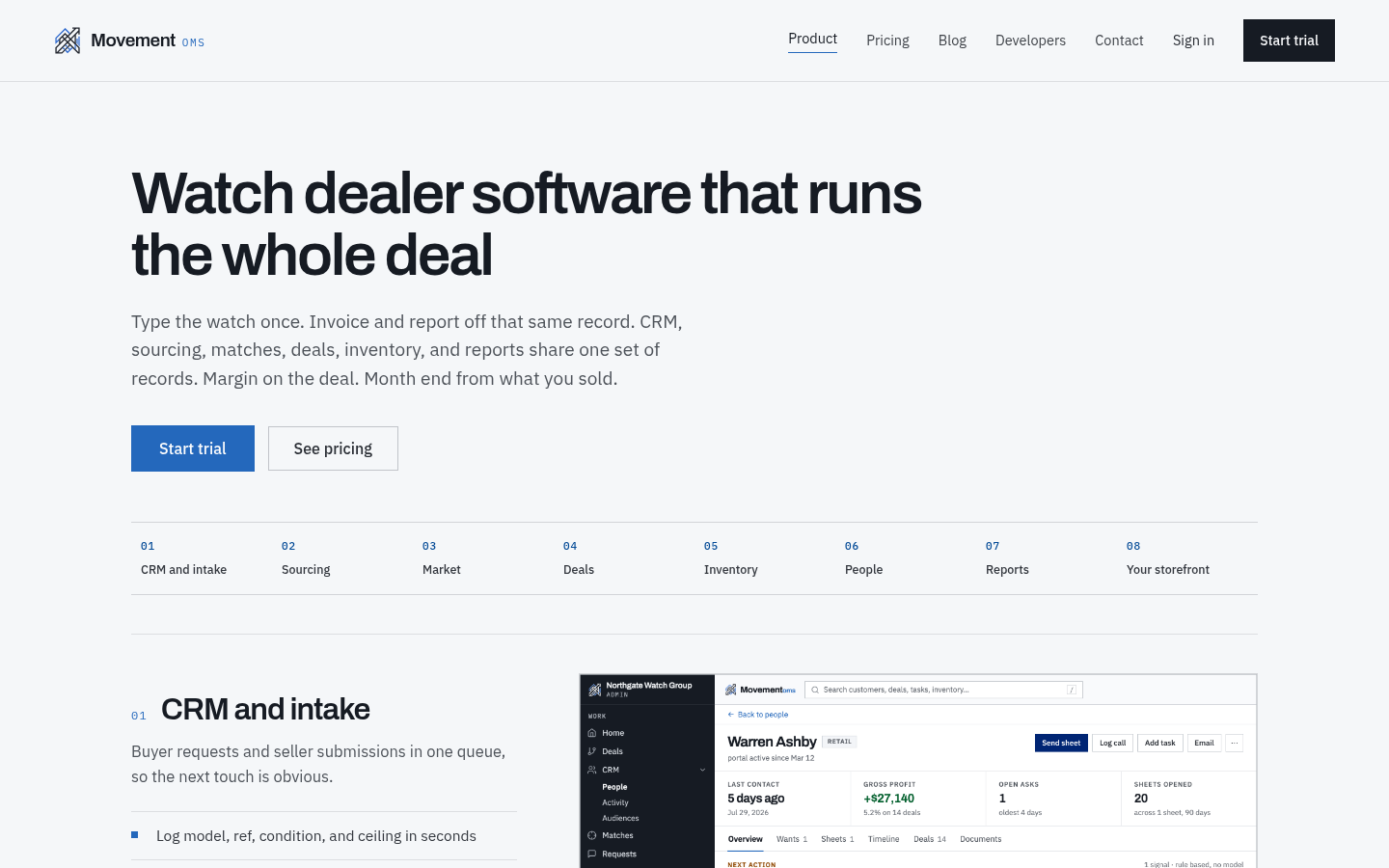
- CRM and intake for buyer requests and seller submissions
- Sourcing queue ordered by overdue and due today, offers on the record
- Matches: open requests against stock you already hold
- Inventory with cost, landed cost, location, owners, and status
- Deals screen with basis, sold price, gross profit, payments, and invoice
- Deal terms and cuts on the deal from day one
- Branded PDF invoices and partial payments
- Close posts to QuickBooks: bill, balance sheet, COGS
- Reports: revenue, gross profit, aging, P&L, export to CSV
- Site updates from the deal; the same feed serves Google Shopping
- Public API for inventory, deals, and leads
- Unlimited seats
The full feature list is on the product page. Pricing is one plan at $299 a month for the whole operation, with unlimited seats; the pricing page lists everything included. The trial runs 14 days at $0 with a card at signup, the first charge is $299 on day 15, and cancelling before then means you are never billed. White-glove onboarding, which covers QuickBooks and your chart of accounts, is a one-time $1,500 on top of the plan. If you are moving off a spreadsheet, email a stock or client list and it gets loaded; past sales come in by CSV. A dealer coming off a spreadsheet has the first deal closed on the record about ten minutes after signup. You can start a free trial and put your next deal through it.